

This is already our 11th year predicting what’s next in B2B sales. When we started listing these trends back in 2015, we didn’t know we were creating an annual routine where we would witness how quickly sales technology evolves. We’ve seen the rise of SDRs, sales automation, personalization, playbooks, and RevenueOps. We’ve followed how AI entered the sales floor. First through predictive analytics, then co-pilots, and now through autonomous agents. If 2025 was the year of copilots and first AI agents, 2026 will be the year when sales teams learn to orchestrate them.
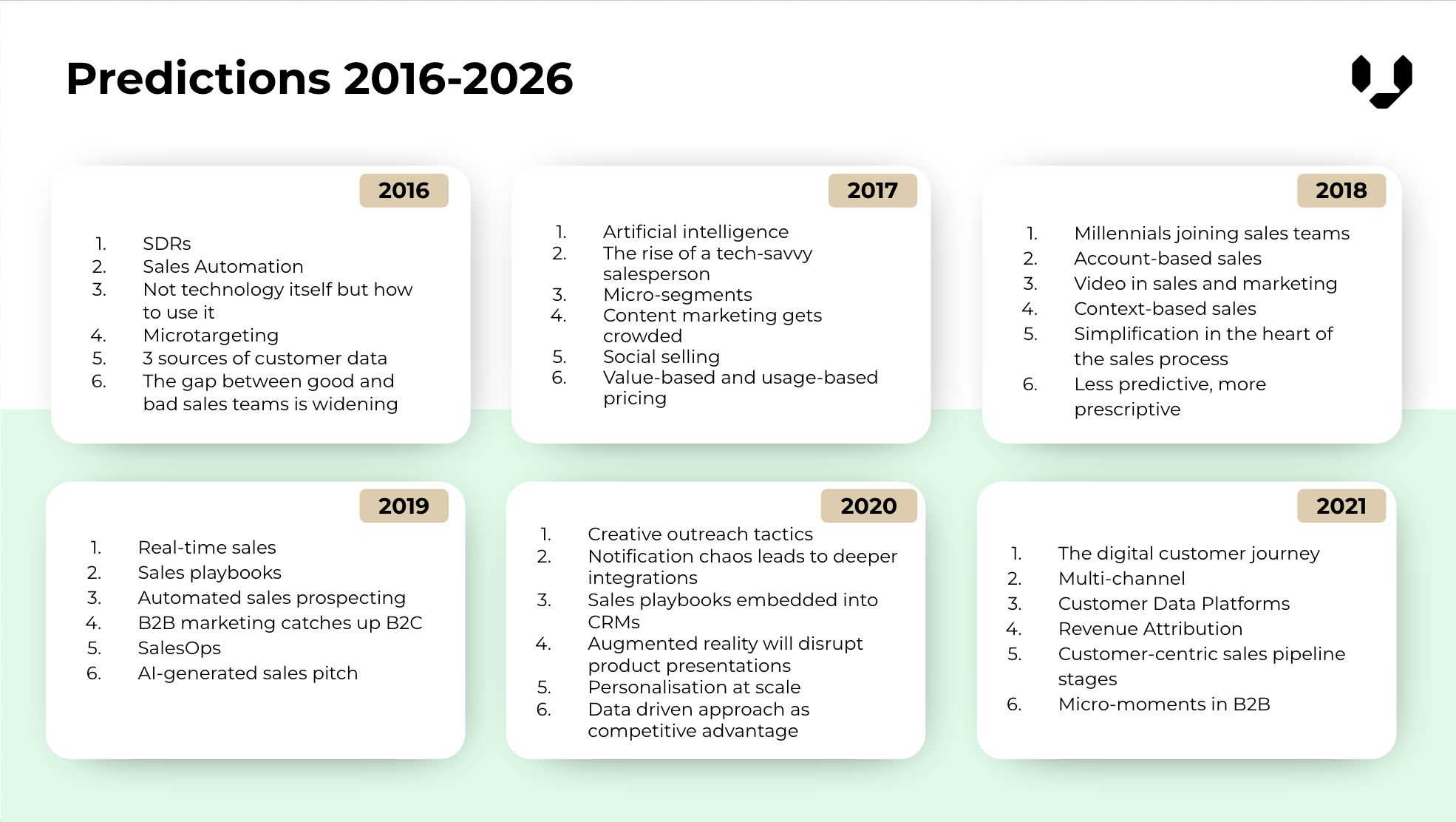
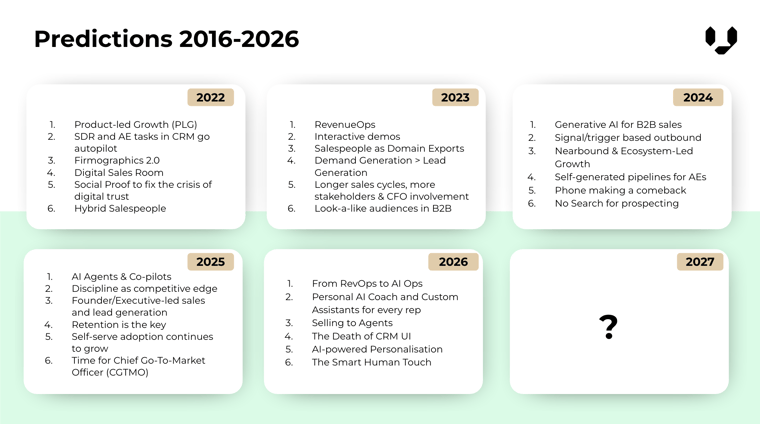
Here are our six B2B sales predictions for 2026:
- From RevOps to AI Ops
- Personal AI Coach and Custom Assistants for every rep
- Selling to Agents
- The Death of CRM UI
- AI-powered Personalisation
- The Smart Human Touch
1. From RevOps to AI Ops
Just when we thought we’d reached the maximum number of “Ops”, another one arrives: AI Ops. Every sales organization will use multiple AI tools and agents. Some that help reps write emails and answer questions, others that analyze calls, suggest next steps, or score leads automatically. This can quickly turn into a chaotic mix of automations where no one knows what’s actually happening.
In 2026, someone must keep the AI orchestra in tune. That means ensuring agents have access to the right data (and nothing more), automations follow privacy and compliance standards, and different systems, such as CRM copilots, marketing bots, and internal agents, don’t duplicate or contradict each other. When companies scale their agentic playbooks, knowing the true origin and reliability of the data your AIs rely on becomes business-critical. This concept is called data provenance.
With dozens of AIs pulling information from different sources, the best sales organizations will treat data quality as a competitive edge. AI Ops professionals will become the guardians of that trust. Responsible not just for dashboards and workflows, but also for AI governance and orchestration. This new layer is what makes the modern GTM stack actually work.
2. Personal AI Coach and Custom Assistants for every rep
Most salespeople have already used ChatGPT and copilots, but 2026 will be the year when these tools evolve into fully personal AI assistants. Reps will customize ChatGPTs and Geminis using MyGPTs or Custom Gems trained on internal company data and sales materials. These assistants will know your process, your product suite, and your meeting history. Connected to meeting transcripts and call recordings, they will coach reps in real time using your preferred frameworks such as BANT or MEDDIC.
For example:
“You spent most of the call on product features but didn’t confirm who the decision-maker is. Want me to draft a follow-up email to clarify that?”
“Tim mentioned his colleague Anita Pettersson owns the ERP project. Would you like me to schedule a short introduction with her?”
Instead of generic sales advice, these AIs will deliver personalized, contextual coaching aligned with company best practices. Sales enablement is shifting from static playbooks to on-demand AI mentors that benchmark each rep against your top performers.
3. Selling to Agents
Next year, your buyer might not be the one answering your call, it could be their AI agent. Apple and others already let users screen calls automatically, and these tools are only getting smarter. Before you reach a human decision-maker, an AI could filter your outreach, summarize your offer, and compare it to competitors.
This means salespeople must also learn to sell to machines. Success will depend on clear, structured, and data-rich messaging that AI can interpret and forward. Reps who rely on buzzwords will struggle, while those who communicate tangible ROI, social proof, and measurable benefits will thrive. In 2026, sales enablement must address a new audience: the buyer’s digital gatekeeper.
4. The Death of CRM UI
CRM has long been both a salesperson’s best friend and biggest headache, but that’s about to change. The traditional CRM interface will start to fade away. Instead of clicking through endless tabs and fields, reps will simply use natural language. You’ll talk to your CRM instead of navigating it.
Examples:
“Show me my meetings this week with a short status summary.”
“Add a note: reach out to Company X’s new logistics director.”
“Show me my hit rate by industry for the past 36 months.”
AI will handle the background work: syncing meetings, emails, and notes automatically. For sales leaders, this means cleaner data. For reps, it means less admin and more customer time.
5. AI-powered Personalisation
We’ve talked about personalization for years, but 2026 will take it to a new level. Generative AI now enables instant creation of hyper-personalized sales content: emails, visuals, or short videos, tailored to each prospect. What once required hours of effort or confidence on camera can now be generated from CRM data in seconds.
AI-driven personalization isn’t about pretending to be human; it’s about being genuinely relevant. Prospects shouldn’t feel like one of a thousand targets in a sales sequence. They should feel like you did your research, even if your AI did most of it. In 2026, smart personalization will distinguish between yet another AI-generated email and a conversation worth replying to.
6. The Smart Human Touch
As AI takes over more of the sales process, the greatest differentiator becomes the timeless one: human connection. For complex or high-trust decisions, people still want to engage with other people. The trick in 2026 is to let AI handle the busywork so that humans can focus on where they matter most.
For example:
- In-person meetings where the rep reads the room, picks up unspoken signals, and builds real trust.
- An executive sponsor personally calling a buyer’s leadership team to show commitment and alignment.
- A genuine follow-up call after a meeting instead of another automated message.
Closing thoughts
Yes, B2B sales in 2026 will be more automated, personalized and AI-driven than ever.
But the sales teams shouldn’t just plug in more tools, they need to focus on orchestrating, personalizing and humanizing their sales work while staying true to the very basics of good selling: being active, systematic and understanding the customer’s context.
AI will handle the repetition and humans will take care of the relationship. That’s how most successful sales teams will approach the year 2026.